
Introduction
Today, that’s no longer a philosophical question. It’s an operational one.
Because here’s the uncomfortable truth: The fastest-growing small businesses in the US aren’t winning because they hired more people, worked longer hours, or discovered some secret marketing hack. They’re winning because their systems execute when humans can’t keep up.
And the stakes are much higher than most business owners realize.
Research shows that businesses responding to a lead within five minutes are 21 times more likely to qualify that lead than businesses that wait just 30 minutes. Yet the average response time across industries is still measured in hours, not minutes. Even more revealing, nearly 78% of customers buy from the first company that responds, regardless of who has the bigger brand or the larger team.
Think about what that means. Your next customer may not choose the best business. They may choose the fastest one.
Messages get answered automatically. Leads get routed instantly. Follow-ups happen without reminders. Campaigns adapt without manual intervention. Not because someone is monitoring every dashboard, but because automation has become part of how the business operates.
And this shift didn’t happen quietly.
Rising advertising costs, shrinking attention spans, labor shortages, and customers who expect immediate responses have pushed small businesses into a new reality. You either build systems that operate at digital speed, or you compete against businesses that already have.
There’s very little middle ground left.
From Task Hacks to Operating Systems
Just a few years ago, automation was considered a productivity upgrade—something businesses invested in after growth created operational headaches. In 2026, the equation has flipped: Automation is what allows businesses to grow before those headaches appear.
Think about the daily reality of most SMBs today:
- Leads arrive from paid ads, websites, marketplaces, and social media.
- Customers message through SMS, WhatsApp, email, live chat, and direct messages.
- Teams juggle sales, support, marketing, operations, and customer retention simultaneously.
Now ask the uncomfortable question: How much of this still depends on someone remembering what to do next?
If the answer is "quite a lot," then growth isn’t being limited by demand. It’s being limited by execution capacity. And that’s where the state of small business automation in the US becomes sharply divided in 2026:
- On one side are businesses using automation to handle isolated tasks—sending emails, confirming appointments, scheduling posts, and triggering reminders.
- On the other are businesses using automation as an operating layer, connecting customer data, conversations, campaigns, and decisions into continuous workflows that execute automatically.
Same markets. Similar team sizes. Completely different outcomes.
In 2026, automation doesn’t simply save time. It protects revenue. It preserves reputation. And increasingly, it determines who scales and who stalls.
The Big Picture: What SMB Automation Adoption Actually Looks Like in 2026
"Most small businesses are automated. Very few are automated well."
That’s the paradox of 2026. On paper, automation adoption across US small businesses looks impressive. Email campaigns are scheduled. Appointment reminders are automated. Social posts go out without manual clicks. Invoices trigger automatically. Chatbots answer basic questions.
So yes, automation exists. But scratch beneath the surface and a different story appears. Most SMBs are automating tasks, not journeys. They’ve replaced small pieces of manual work… but the handoffs between systems still depend on humans.
A lead might get captured automatically, but:
- Someone still has to assign it.
- Someone still has to decide the follow-up.
- Someone still has to check which campaign brought it in.
- Someone still has to update the CRM later (if they remember).
That gap between automated moments is where growth quietly leaks. This is why adoption looks high, but impact feels limited.
The 3 Automation Maturity Groups in 2026
-
Level 1: Task Automators
These businesses automate individual actions like email sequences, payment confirmations, booking reminders, and basic chat replies.
Useful? Absolutely. Transformational? Not really. They save minutes, but not momentum. -
Level 2: Partial Workflow Builders
Here, systems start talking to each other—leads flow into CRM, some follow-ups are triggered, and campaign tools connect with contact lists. But the experience is still stitched together. Different dashboards. Different data rules. Different versions of the customer story. When something breaks, humans become the glue again. -
Level 3: Execution-Driven Automation
This is where automation becomes operational, not cosmetic. Actions trigger actions:- New leads auto-route to the right rep.
- Conversations update customer stages in real time.
- Campaign responses adjust next steps automatically.
- Reviews, ads, and support signals influence outreach.
No one is asking, "What should I do next?" The system already knows.
Most SMBs are still stuck between Level 1 and Level 2—not because they don’t want better automation, but because their tools were never designed to think in connected workflows.
Which leads to the real dividing line in today’s market: Not automated vs. non-automated, but fragmented automation vs. unified automation. And only one of those actually scales.
What SMBs Are Automating Well (And Why These Areas Went First)
"SMBs didn’t automate strategy first. They automated survival first."
When small business owners looked at their daily chaos, they didn’t start with big transformation goals. They started with the loudest problems—the ones eating time, dropping balls, and burning out teams. The first wave of automation in the US focused on three practical zones:
1. Customer Messaging
This is where automation felt urgent: auto-replies on WhatsApp and website chat, chatbots answering FAQs, and appointment confirmations and reminders. Fast replies protect revenue, and basic messaging automation feels like hiring an extra staff member.
2. Marketing Execution
Next came repeatable promotions like email drip sequences, broadcast campaigns, and scheduled social posts. Marketing moved from "whenever we remember" to "at least something goes out."
3. Lead Capture
Then came the front door: website forms, click-to-message ads, and lead sync into CRMs or spreadsheets. Leads were no longer getting lost in inboxes.
The Hidden Catch
Most of this initial automation remains:
- Reactive: It responds; it doesn’t guide.
- Channel-specific: Each tool only knows its own job.
- Disconnected from outcomes: No clear visibility into what actually converted into revenue.
Here’s a painfully common 2026 workflow:
Lead fills a form ➔ Instant email sent ➔ Rep calls later (maybe) ➔ No campaign attribution ➔ Follow-up missed if call fails ➔ CRM updated sporadically
Small businesses have automated movements, but they have not automated momentum. They built machines that react, not systems that think. Automating steps without connecting them doesn’t create scale—it creates faster chaos.
Where Automation Is Still Failing Small Businesses
"Automation didn’t fail. Implementation strategy did."
On paper, auto-replies are on, emails are scheduled, forms are connected, and campaigns are running. So why does growth still feel manual? Because automation stops exactly where execution starts to matter.
1. Cross-Channel Coordination Is Still Broken
Customers don’t live in channels; they live in journeys. When WhatsApp conversations live in one app, email campaigns in another, CRM leads in a third, and ad data in a fourth, nothing updates together. When a customer clicks an email, chat doesn’t know. When a deal closes, ads don’t learn from it.
2. Follow-Ups Still Depend on Human Memory
Without behavior-based triggers or automated routing when intent spikes, reps rely on notes, reminders, and "I’ll follow up tomorrow." Response speed becomes inconsistent, and deals quietly fade away.
3. Attribution Is Still Guesswork
Ask most SMBs which campaign drove their last five sales, and you’ll get guesswork. Without connecting Campaign ➔ Conversation ➔ Follow-up ➔ Conversion, teams cannot double down on what works.
4. Ownership Gets Lost After Automation Fires
Automation sends the message, but who owns the reply? Who takes over the lead? When responsibility isn't baked into workflows, deals die in the handoff.
"If your system doesn’t push the next action, it’s not automation. It’s scheduling."
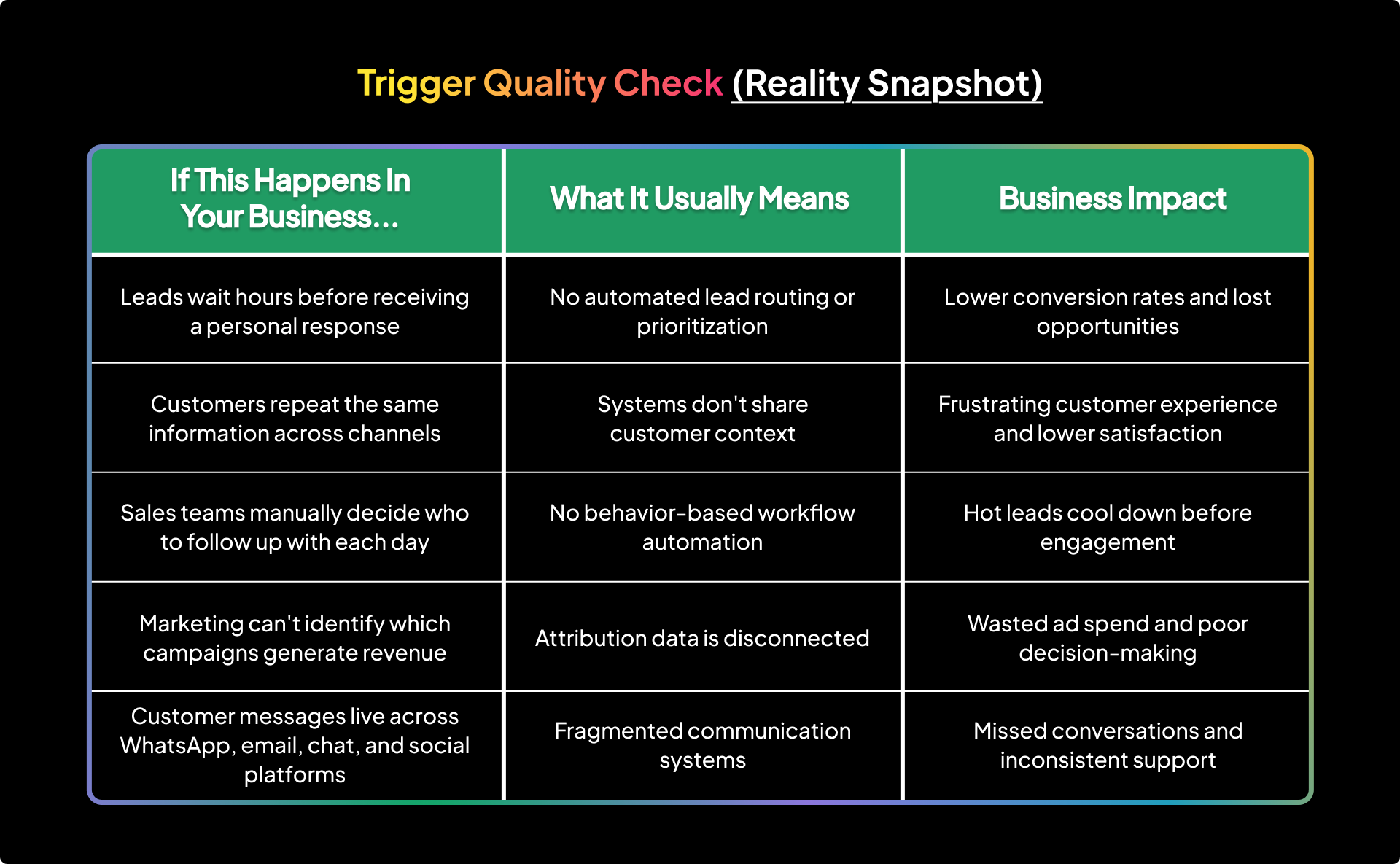
Quick Self-Assessment
If you checked four or more of the situations above, your business likely doesn't have an automation problem—it has a workflow architecture problem.
The goal isn't to automate more individual tasks. The goal is to create a connected system where every customer action automatically triggers the next business action, without relying on memory, manual intervention, or constant supervision.
The Rise of Automation as a Business Operating Layer
"The smartest SMBs stopped automating tasks. They started automating outcomes."
For years, automation lived inside marketing tools. Email automation. Ad automation. Chat automation. In 2026, that siloed model is breaking down in favor of a unified business operating layer.
The 2026 Shift
| From (Legacy) | To (Modern OS) |
|---|---|
| Tools | Connected Systems |
| Features | Workflows |
| Channels | Customer Journeys |
| Reports | Next-Best Decisions |
Instead of: "Send this message."
Modern automation executes: "If this happens, move the deal, notify the owner, trigger follow-up, adjust campaign targeting, and log the outcome."
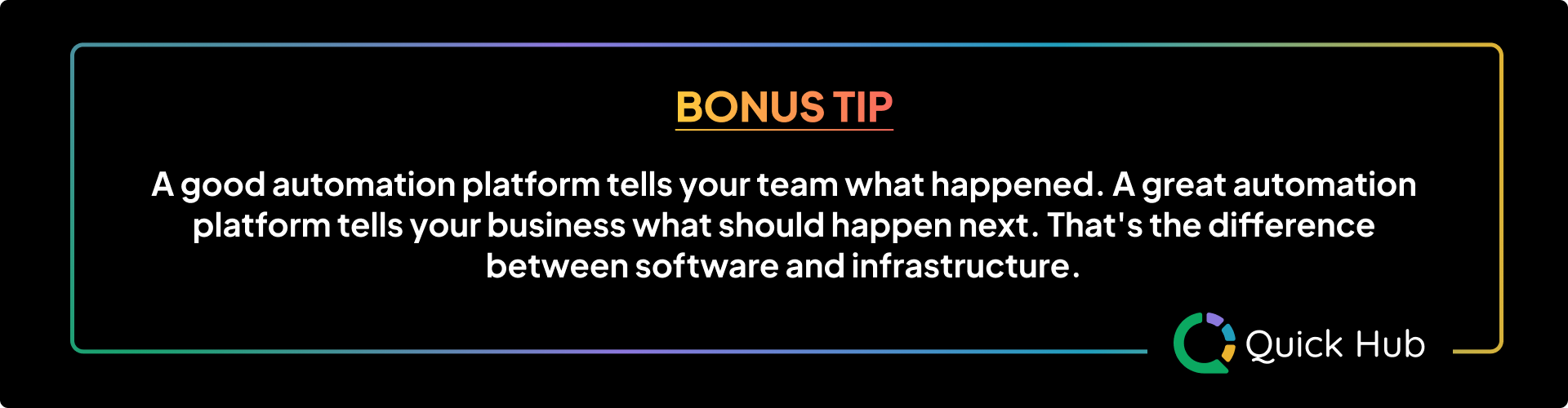
In modern setups, core functions no longer live in separate universes. CRM, chat, campaigns, ads, reviews, and AI assistants share:
- One data layer: Everyone sees the same single customer view.
- One workflow engine: Actions move across departments automatically.
When a customer replies, the system doesn't just log it—it updates status, assigns responsibility, adjusts messaging, and adapts future retargeting without manual syncing.
Privacy, Trust, and Compliance Are Now Automation Features
"In 2026, trust is no longer a branding exercise. It’s a system requirement."
Today’s customers are sharper, more skeptical, and far more aware of how their data is handled. AI-driven discovery platforms and search algorithms actively reward brands that behave responsibly over brands that spam aggressively.
What Automation Systems Must Handle by Default:
- Consent tracking across all communication channels
- Data usage boundaries between internal teams and third-party tools
- Real-time communication preferences
- Instant opt-outs that automatically halt active workflows
Brands that automate with respect see higher response rates, superior deliverability, lower legal risk, and greater customer retention. Privacy-first automation isn’t slower—it’s smarter.
What High-Growth SMBs Are Doing Differently
"Growth in 2026 is not about working faster. It’s about removing friction."
Across fast-scaling small businesses, consistent patterns emerge:
- Fewer tools, deeper integrations: One connected platform beats five disconnected dashboards.
- Automation tied to revenue outcomes: Workflows are built around business milestones, not arbitrary task triggers.
- Centralized customer intelligence: Marketing, sales, and support operate with full historical context.
- AI embedded into workflows: Generative AI assists with response drafting, lead prioritization, and sentiment detection right inside the active pipeline.
High-growth teams ruthlessly eliminate app sprawl and manual data reconciliation. As one growth operator put it: "If your automation doesn’t move revenue, it’s just digital busywork."
Strategic Playbook: How SMBs Should Upgrade in 2026
"You don’t need more tools. You need better flow."
Rebuilding automation doesn't require an enterprise budget. It requires aligning systems with how customers actually move through your pipeline.
- Step 1: Centralize Customer Data
Create a single source of truth where all conversations, purchases, and touchpoints live in one unified customer profile. - Step 2: Automate Decision Points, Not Just Tasks
Deploy triggers based on behavior, intent, and engagement signals rather than static calendar timers. - Step 3: Unify Channels into One Workflow
Connect inbox, campaigns, ads, social, and chat into a seamless journey that preserves context. - Step 4: Add AI Where Humans Slow Down
Use AI to draft responses, score leads, and identify patterns while humans focus on high-touch relationships. - Step 5: Build for Trust, Not Just Reach
Respect consent and data boundaries to ensure every interaction builds lasting credibility.
Quick Wins vs. Long-Term Moves
- In the Next 30 Days: Consolidate inboxes, standardize handoffs, and implement behavior-based follow-ups.
- Over 6–12 Months: Migrate to a unified data architecture, implement predictive routing, and embed AI natively into your operations.
The Core Pattern Behind Every High-Performing SMB
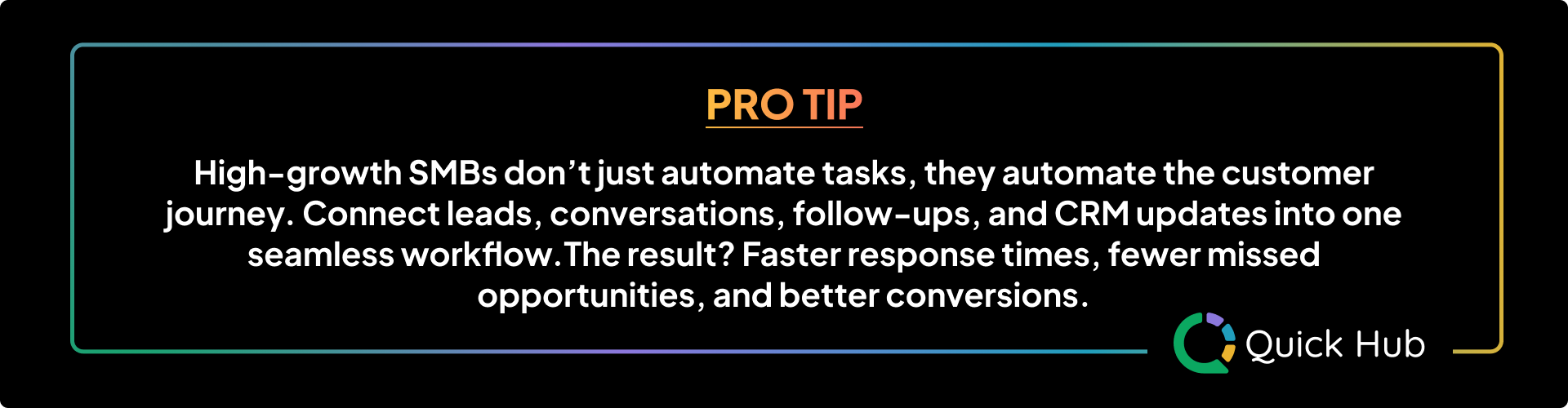
The businesses scaling fastest in 2026 reduce three critical friction points:
- Manual decisions
- Disconnected workflows
- Execution delays between customer intent and business action
When systems handle coordination automatically, growth ceases to feel chaotic and becomes truly repeatable.
Final Takeaway: Automation Is the New Business Skill
"In 2026, the businesses growing the fastest aren’t necessarily working harder. They’re executing smarter."
Small businesses today compete in an environment where customers demand instant replies, personalized communication, and flawless coordination. Lean teams cannot bridge this gap with effort alone—they need intelligent systems that work around the clock.
This is why modern SMBs are shifting to platforms like QuickHub. Rather than automating isolated tasks, QuickHub provides a unified business operating layer:
- Lead enters pipeline ➔ Auto-routed to the right owner instantly.
- Customer replies on WhatsApp ➔ CRM updates in real time.
- Prospect demonstrates intent ➔ Contextual follow-up triggers automatically.
- Campaign converts ➔ Future ads and outreach adapt automatically.
Every manual handoff is friction. Every disconnected tool is a delay. And every missed follow-up is revenue lost to a faster competitor.
Ready to See Modern SMB Automation in Action?
If your business is still juggling leads, conversations, follow-ups, and campaigns across disconnected tools, the issue is no longer productivity—it’s scalability.
Book a free QuickHub demo and see how modern SMBs leverage unified automation, AI workflows, CRM, website chat, and multi-channel campaigns to scale efficiently without operational chaos.