

Marketing Didn’t Change Overnight. It Crept in Quietly… and Then Took Over.
First, we automated emails because sending them manually was painful. Then we automated follow-ups because people forgot. Then campaigns, because growth demanded scale. And somewhere in between… automation stopped helping.
It started deciding.
Today, marketing automation doesn’t just send messages. It decides:
- Who gets seen?
- Who gets ignored?
- And who gets remembered?
That’s the part most businesses still haven’t fully processed. What started as simple rule-based workflows has evolved into systems that read intent, predict behavior, personalize journeys, and respond instantly across channels. This isn’t backend support anymore. This is control. And by 2026, there’s no going back.
Automation won’t be judged by how much time it saves. It’ll be judged by how well it thinks, anticipates, and adapts. If you’re still treating it like scheduled messages and basic funnels, you won’t just fall behind. You’ll feel irrelevant, even if you’re spending more.
This isn’t another “top trends” blog. This is the real evolution:
- Where automation started.
- Why each phase happened.
- What broke along the way.
- And what actually matters next.
Because automation isn’t something that’s coming. It’s already here. And it’s already deciding who wins. To understand where marketing automation is heading in 2026, you have to go back to a time when nothing was automated, when growth depended on effort, not systems.
ACT I: Before Automation Existed (Pre-1990): When Marketing Was Muscle, Not Software
- Era: Pre-digital.
- Mood: Hustle, chaos, human memory.
- Core Enemy: Forgetting.
“The palest ink is better than the best memory.” — Chinese Proverb
Long before dashboards and drip campaigns, marketing ran on something dangerously unreliable: human recall.
Picture a sales rep in 1985. A desk stacked with folders labeled by hand. A Rolodex spinning like a casino wheel. Follow-ups scribbled on sticky notes, some yellowed with age. A landline ringing nonstop. Miss one call, and the lead doesn’t go into a nurture sequence. It disappears completely.
This was the era when marketing meant showing up. Literally. Phone calls, fax machines, handwritten notes, and direct mail ruled the funnel. Campaigns weren’t optimized, they were endured. Measurement took weeks. Feedback loops took months. And attribution? It barely existed.
There was no automation because there was no system to automate. The system was the person. And people, as it turned out, were the bottleneck.
By the late 1980s, research showed the average salesperson could actively manage fewer than 50 relationships at a time. Not due to lack of effort, but because attention, memory, and energy are finite. Growth didn’t slow because of poor ideas. It slowed because humans can only remember so much.
As management thinker Peter Drucker later put it:
“Efficiency is doing things right. Effectiveness is doing the right things.”
In this era, marketers struggled with both, not because they were ineffective, but because they had no leverage. Every reminder had to be remembered. Every follow-up had to be manual. Every customer relationship lived inside someone’s head. Marketing didn’t yet need intelligence. It didn’t yet need prediction. It didn’t yet need personalization. It needed memory that didn’t forget. And once businesses realized forgetting was costing revenue, reputation, and relationships, one truth became clear:
Automation wasn’t a luxury. It was survival.
That realization is what pulled marketing into its first technological evolution.
ACT II — 1990–1999: The CRM Is Born (Automation’s First Body)
- Era: Early digital.
- Mood: Relief, order, false security.
- Core Promise: “At least we won’t forget anymore.”
“The first breakthrough wasn’t automation. It was not forgetting.”
The 1990s didn’t introduce intelligence to marketing. They introduced memory that didn’t die when an employee quit.
ACT! Marketing Automation, a platform for sales and marketing was one of the first to crack the problem. Contacts, notes, and follow-ups finally lived inside a computer instead of a desk drawer. Then came Siebel Systems in 1993, bringing CRM into the enterprise world, massive databases built to track customers across sales teams, regions, and time.
For the first time, businesses could answer questions like:
- Who did we talk to last quarter?
- What was promised?
- When was the last interaction?
This felt revolutionary. Rolodexes disappeared. Filing cabinets shrank. Sales managers finally had visibility. By the end of the decade, over 40% of large enterprises had adopted some form of CRM.
But here’s the uncomfortable truth: CRMs didn’t do anything.
They stored data. They didn’t act on it. They didn’t remind you. They didn’t respond. And they didn’t predict.
As one sales leader famously joked in the late ’90s:
“A CRM is just an extremely costly place to forget your prospective customers digitally.”
Data went in. Nothing came out. No triggers. No workflows. No follow-ups unless a human remembered to check the system. Marketing still depended on discipline. Sales still depended on effort. And growth was still limited by how often someone logged in, updated records, and manually decided what to do next.
The CRM gave automation its first body, but no brain. It solved the problem of forgetting the past, but not the harder problem: What should happen next?
That question would haunt marketing teams for the next decade, until the internet, email, and scale collided. And when they did, storage was no longer enough.
ACT III: 2000–2005: The First Marketing Automation Platforms Appear
- Era: Early internet growth.
- Mood: Ambition, experimentation, and overwhelm.
- Defining Shift: Marketing tries to scale itself for the first time.
By the early 2000s, something had fundamentally changed. Email was everywhere. Websites were generating leads at scale. Inbound demand was no longer scarce, attention management was.
Eloqua was developed in 1999 and is largely regarded as the first real marketing automation platform. For the first time, marketing software didn’t just store data, it reacted to it. This was new. And it was powerful.
Eloqua introduced concepts that now feel obvious but were radical at the time:
- Email automation triggered by behavior.
- Lead scoring based on engagement.
- Multi-step campaign workflows.
- Early behavioral tracking across web and email.
Instead of blasting the same message to everyone, marketers could finally nurture leads over time. A whitepaper download didn’t mean “call immediately.” It meant “educate, warm, and wait.” Early adopters saw up to 30% higher lead conversion rates, proving one thing clearly: Timing beats volume.
But innovation came with a brutal cost.
These platforms were expensive, fragile, technically demanding, and designed almost exclusively for large enterprises. Running marketing automation in this era felt less like marketing and more like operating a flight control system. Entire teams were needed just to design workflows, manage scoring models, and fix broken campaigns.
As one early adopter reportedly said:
“The software was brilliant. Using it felt like a second job.”
Automation now had a brain, but it was inaccessible to most businesses. SMBs were locked out. Non-technical teams were overwhelmed. And speed still depended on specialists. Automation existed, but only the biggest players could afford the brainpower to run it. The next evolution wouldn’t be about more power. It would be about usability, speed, and reach. And that shift was coming fast, with SaaS, the cloud, and a new generation of tools.
ACT IV: 2006–2012: Inbound, SMBs, and the Democratization Era
- Era: SaaS boom, content explosion.
- Mood: Optimism, accessibility, and scale.
- Defining Shift: Automation leaves the enterprise and enters the mainstream.
“Automation finally came down from the ivory tower.”
When HubSpot launched in 2006, it didn’t just introduce new software, it introduced a new belief system. Instead of chasing leads, businesses could attract them. Instead of cold calls, there was content. Instead of massive budgets, there was inbound. For the first time, small and medium-sized firms could compete with corporations in the automation game without having to hire a technical army.
This age combined three ideas into a single growth engine: content marketing, email automation, and CRM-driven lifecycle tracking. Platforms like HubSpot, followed by Marketo and Pardot, made automation feel approachable. There was no need for you to be a data scientist. You needed a blog, an email list, and a few well-timed workflows.
Key innovations defined this period:
- Drip campaigns that educated leads over time.
- Lead magnets that traded value for contact details.
- Lifecycle stages that mapped awareness → consideration → decision.
- Behavioral email alerts triggered by clicks, opens, and downloads.
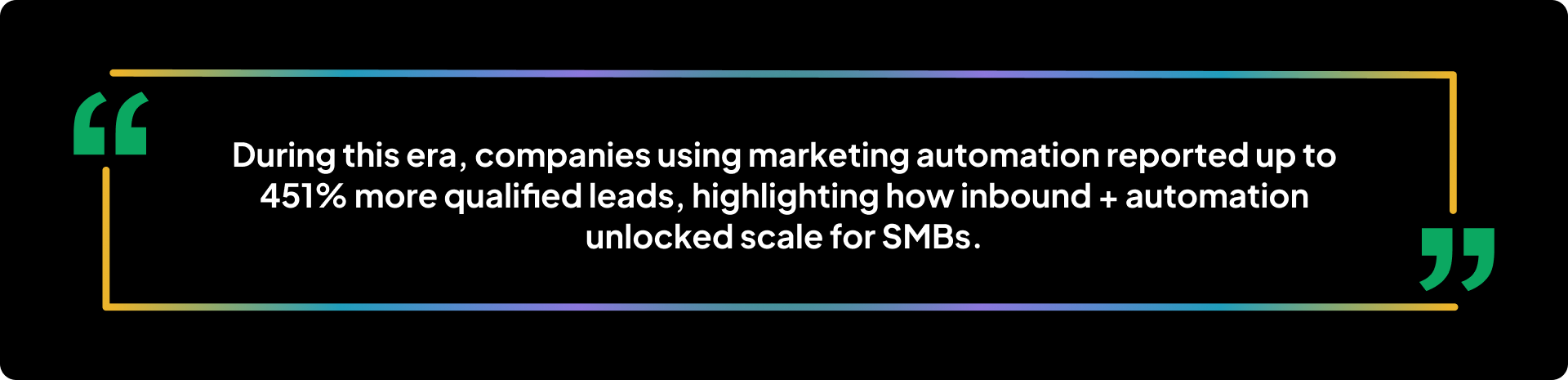
The results were undeniable. Companies using automation in marketing generated up to 451% more qualified leads, according to data widely cited during the HubSpot growth wave.
A new mantra emerged:
“Set it once. Let it run.”
And for a while, it worked. But beneath the success, a quiet problem was forming. Automation became rigid.
Workflows were built on fixed rules:
- If this happens, send that.
- If they click, wait three days.
- If not, move them to another list.
The system didn’t learn. It didn’t adapt. It didn’t understand the context. As channels multiplied and buyer behavior became less linear, these static workflows started to feel brittle. SMBs had automation, but not intelligence. What worked at 1,000 leads began breaking at 100,000 interactions. The next era wouldn’t be about accessibility anymore. It would be about speed, personalization, and coordination across channels.
And that’s where things started to get… messy. Really messy.
ACT V: 2013–2017: The Rules Engine Era (If This, Then That Marketing)
- Era: Workflow obsession, funnel diagrams everywhere.
- Mood: Control, predictability, and false confidence.
- Defining Trait: Automation that executes perfectly, but understands nothing.
“Automation understood how to adhere to rules, but not how to think.”
By 2013, marketing automation had matured into something deceptively powerful: rules engines. Every platform promised the same thing: control. Control over timing. Control over messaging. Control over the funnel.
Marketers built elaborate flowcharts that looked like subway maps:
- If a user signs up → send Email A.
- If they click → wait three days → send Email B.
- If they don’t → branch them into a re-engagement sequence.
It worked because it was predictable. For the first time, marketing felt engineered. Campaigns could be tested, measured, and optimized. Funnels could be replicated. Teams could scale output without scaling headcount. This era rewarded discipline. But here’s the crack that widened into a fault line:
Customers didn’t behave like flowcharts.
They bounced between devices. They consumed content out of order. They engaged across channels simultaneously. They ignored timing assumptions baked into workflows. Rules-based automation couldn’t adapt mid-journey. It couldn’t sense urgency. It couldn’t recognize intent shifts. It couldn’t pause when the context changed. As inboxes flooded with perfectly timed but poorly timed messages, fatigue set in.
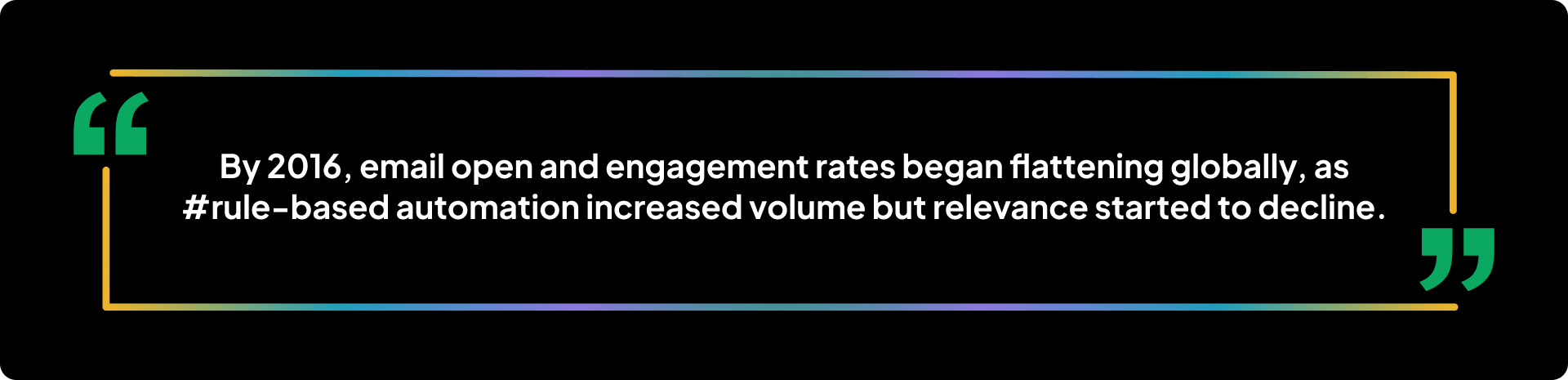
By 2016, industry-wide data showed email open rates flattening and engagement rates beginning to decline, not because content got worse, but because relevance did. Automation was firing on schedule, not on signal.
A famous management quote suddenly applied to marketing:
“What gets measured gets managed, even when it stops making sense.”
Rules scaled actions. They scaled volume. They scaled noise. But they did not scale understanding. And that’s when marketers began stacking tools to compensate: social schedulers, chat tools, ad platforms, and analytics dashboards. The next era wouldn’t fix this problem. It would accidentally multiply it.
That’s when marketing automation stopped being a system, and started becoming a stack.
ACT VI: 2018–2021: The Tool Explosion & SaaS Overload
- Era: App gold rush.
- Mood: Busy, bloated, and duct-taped.
- Defining Trait: Automation everywhere, execution nowhere.
“Automation didn’t get smarter. It multiplied.”
By 2018, marketing automation didn’t feel like a system anymore. It felt like a shopping list:
- One tool for email.
- One for ads.
- One for landing pages.
- One for chat.
- One for reviews.
- One for analytics.
- One for attribution.
- One for scheduling.
- One for automation between the tools.
Stacks grew fast because vendors promised specialization. “Best-in-class” became the mantra. And on paper, it made sense.
In reality, every new tool added another login, another dashboard, another data silo, another handoff. Automation didn’t disappear, it fractured. Customer journeys broke invisibly. A lead clicked an ad… but the CRM didn’t know why. A chat conversation happened… but marketing never saw it. A review came in… but sales never followed up. Teams became human middleware, copying context from tool to tool.
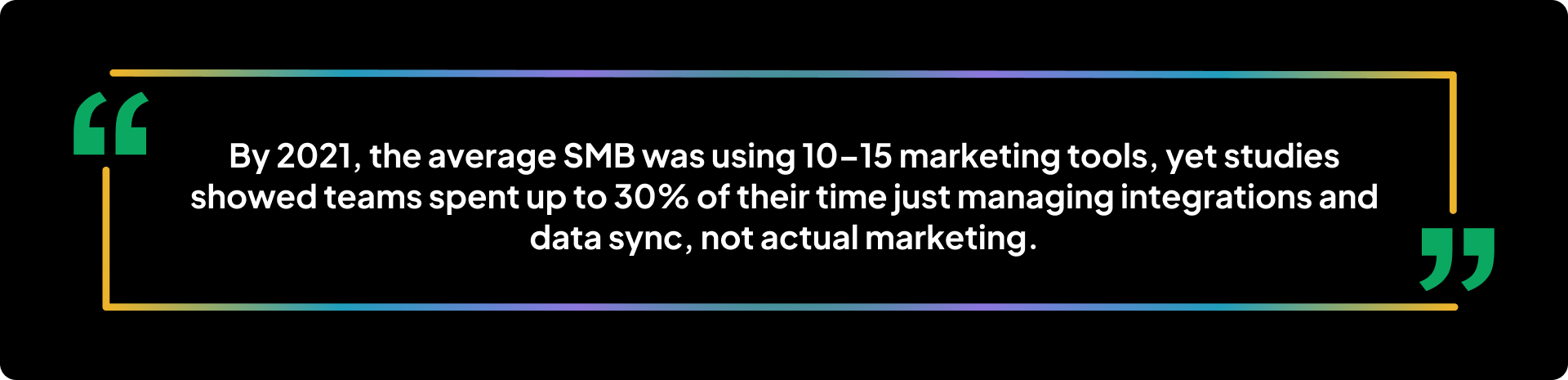
By 2021, the average SMB was running 10–15 marketing tools simultaneously, each automating its own lane, none owning the full journey.
Here’s the cruel irony of this era: Automation increased manual work.
People spent more time syncing data, checking status, asking “Did anyone reply?”, and reconciling reports. Execution slowed down, not because teams were lazy, but because systems didn’t talk. The SaaS boom promised leverage. What it delivered was operational drag. Marketing leaders started to feel something was deeply wrong. Not with effort. Not with talent. But with architecture. The question quietly shifted from “Which tool should we add next?” to something far more dangerous for SaaS vendors:
“Why does this feel harder than before?”
ACT VII: 2022–2024: AI Enters the Room (But Mostly as a Feature)
- Era: AI hype cycle.
- Mood: Hopeful, curious, and confused.
- Defining Trait: Intelligence sprinkled, not embedded.
“AI arrived quietly, inside buttons labeled ‘Optimize’.”
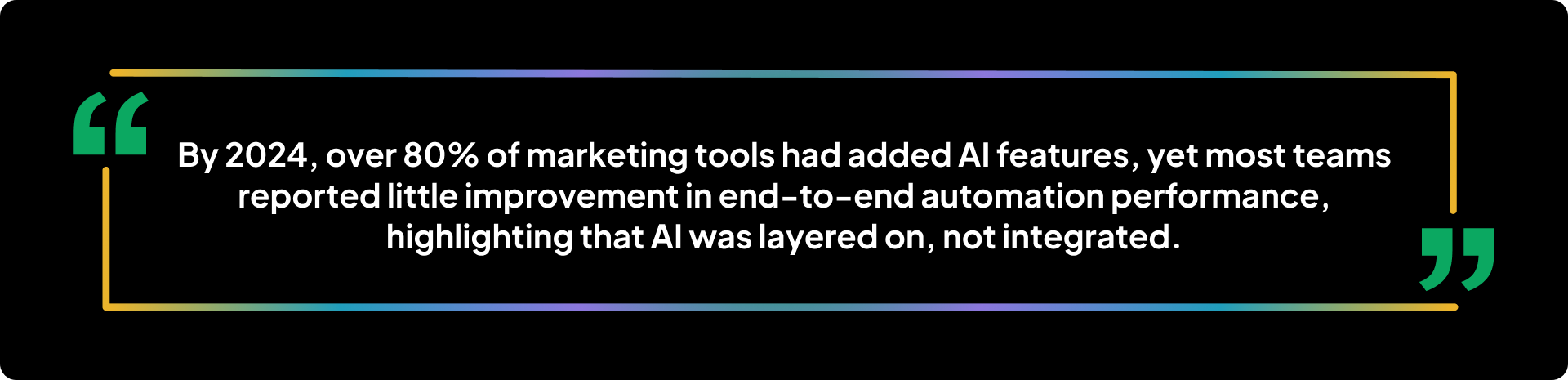
When AI finally entered marketing automation, it didn’t kick the door down. It slipped in politely. Suddenly every platform had AI-generated subject lines, copy suggestions, smart send times, basic predictions, and auto-tagging. It looked like progress. And in small ways, it was. Marketers could move faster. Content production accelerated. Campaign setup got easier. But something felt… unchanged.
The outputs were smarter. The systems were not. AI helped humans write better emails. It didn’t help automation understand when not to send. AI could suggest copy. It couldn’t resolve broken journeys across tools. AI predicted churn. But workflows still waited for humans to act.
The core logic of automation — rules, triggers, sequences — stayed frozen in time. AI was bolted on as a feature, not woven in as the brain.
As one CTO famously put it during this era:
“We added intelligence to the interface, not to the infrastructure.”
So while marketers talked about “AI-powered automation,” the reality was closer to AI-assisted manual work. Smarter buttons. Same fragmented stack. Same human glue. This era revealed a brutal truth: AI cannot fix broken systems. It only exposes them faster.
By 2024, forward-thinking teams realized the problem was no longer tools, or even AI. It was how automation was designed in the first place. And that realization set the stage for the next and most important shift yet.
ACT VIII: 2025–2026: Automation Becomes an Intelligence System
- Era: Systems thinking.
- Mood: Calm, fast, and controlled.
- Defining Trait: Decisions move from humans to systems.
“This is where automation stops executing, and starts deciding.”
By 2025, something fundamental breaks from the past. Automation is no longer a collection of workflows waiting to be triggered. It becomes an intelligence system, one that observes, predicts, and acts before humans even notice the need. This is the moment marketing automation grows a brain.
Instead of asking, “What should we send next?”, systems ask: “What is the customer likely to do next, and what response increases trust?”
Several forces converge at once:
- Predictive analytics stop being dashboards and become decision layers, flagging churn risk, intent spikes, and sentiment shifts in real time.
- AI search discovery replaces traditional browsing. Customers don’t scroll. They ask. Automation now feeds AI engines with structured, trustworthy signals to win visibility.
- Reputation becomes a system input, not an output. Reviews, ratings, and sentiment directly influence reach, conversion, and AI confidence.
- Omnichannel context becomes mandatory. Conversations, campaigns, ads, and follow-ups no longer live in separate tools, they share memory.
- Privacy-first personalization reshapes targeting. Consent, transparency, and first-party data become growth assets, not legal constraints.
The deeper shift is architectural.
Automation moves:
- From workflows → decision engines.
- From calendars → signals.
- From tools → operating systems.
Execution no longer depends on someone remembering what to do next. The system knows. Early data already shows the impact. Businesses using predictive, system-driven automation report 30–40% faster response times, higher retention, and fewer handoffs, not because teams work harder, but because systems remove hesitation.
This era ends a long-standing illusion. Growth is no longer about adding features or stacking tools. It’s about reducing friction between intent and action. Automation finally does what it was always meant to do: not automate tasks, but run the business intelligently. And once businesses experience this shift, there is no going back.
The Final Evolution: Marketing Automation as a Business OS
- Era: Systems over software.
- Mood: Quietly powerful.
- Defining Trait: The business runs itself, intelligently.
“The endgame was never better campaigns. It was better decisions.”
This is where the story lands. Not with another feature. Not with another dashboard. But with a realization that took decades to arrive:
Marketing automation was never meant to sit next to the business. It was meant to run it.
By the mid-2020s, the cracks in the old model became impossible to ignore. Campaign tools optimized messages but ignored conversations. CRMs stored data but didn’t act on it. Analytics reported problems after revenue was already lost. Every system knew something, but no system knew everything. So the final evolution begins. Marketing automation stops being a department-level solution and becomes a Business Operating System.
Here’s what defines this end state:
- One data layer — no syncing, no exports, no “source of truth” debates.
- One execution brain — decisions made once, applied everywhere.
- One continuous loop — every customer action automatically triggers the next best move.
A message isn’t sent because it’s Tuesday. A follow-up doesn’t happen because someone set a reminder. Actions happen because the system detects intent, context, and risk, and responds instantly. This is the moment marketing, sales, support, and growth stop operating as silos and start behaving like one organism.
And this is where platforms like QuickHub appear, not as another tool in the stack, but as a unified customer operations OS. A system designed to connect CRM, chat, campaigns, ads, social, reviews, automation, and AI agents into one shared intelligence layer.
No handoffs. No memory gaps. No execution lag.
The business doesn’t ask, “What should we do next?” Because the system already knows. That’s the final evolution. Marketing automation doesn’t just help teams work faster. It removes the need to decide at every step. And in a world moving at AI speed, that’s not just an advantage, it’s survival.
Final Takeaway: Every Era Solved One Problem, and Created the Next
“Automation didn’t fail. It evolved faster than our thinking.”
That single line explains the entire history of marketing automation. Every era arrived with a promise, and left behind a new limitation:
- The pre-digital age solved reach, but collapsed under memory.
- CRMs solved forgetting, but stalled at storage.
- Early automation solved scale, but demanded specialists.
- Inbound tools solved access, but locked teams into rigid rules.
- Rules engines solved consistency, but ignored context.
- Tool stacks solved coverage, but shattered execution.
- AI features solved output, but not decision-making.
Each phase fixed yesterday’s pain, and exposed tomorrow’s problem.
That’s the pattern. Automation never broke. Our expectations lagged behind its role. Because the real job of automation was never sending emails, scoring leads, or scheduling campaigns. Those were stepping stones. The real destination has always been anticipation.
- Knowing what to do before it becomes urgent.
- Acting while intent is still alive.
- Responding with context, not scripts.
So the questions now are unavoidable:
- Is your automation reacting, or anticipating?
- Is it executing tasks, or shaping outcomes?
- Are you managing tools, or running a system?
From Rolodexes to AI-powered decision engines, automation in marketing has chased the same ambition for forty years:
Doing the right thing, at the right time, without needing to remember.
In 2026, that ambition finally has the intelligence to match it.