
Introduction
"Conversion in 2026 Isn't Persuasion, It's Response."
"The lead doesn't care what you sell. It cares how fast you show up."
Today, fast lead response for SMBs isn't a nice-to-have, it's a competitive edge. Buyers scroll faster, click quicker, and expect instant replies across every channel. Attention windows are shrinking day by day, and every missed minute costs opportunity.
Leads responded in under 2 minutes convert 3–5x higher than those left waiting. This is conversion velocity in action.
Yet, most SMBs still rely on scattered inboxes, spreadsheets, and unconnected apps. One lead might touch WhatsApp, Instagram DMs, website forms, and emails, each siloed. No centralized ownership. No follow-up automation. No visibility into progress.
The result? Missed messages, cold leads, and campaigns that feel like guesswork. That's the harsh reality of lead management.
The modern truth is simple: conversion isn't persuasion-first anymore. It's execution-first. It's showing up instantly, consistently, and on the channels your customers actually use. Multi-touch follow-ups, personalized replies, and instant engagement aren't optional, they're revenue drivers. Every delayed response is lost trust, lost momentum, and lost dollars.
SMBs that thrive today are the ones treating every lead like live fire: every interaction logged, every response automated, every follow-up triggered. If speed is now the currency, the question isn't "how do I sell better?"
It's: "How do I capture attention reliably without chaos?" That's the bridge to building a modern growth system that turns fleeting clicks into predictable revenue, a system where your CRM, automation, and messaging actually talk to each other.
Why Traditional CRMs Are Failing Modern SMBs
"CRMs were built to store, not to act."
Most small businesses bought a CRM believing it would magically fix sales chaos. What they actually got was a digital filing cabinet. Names go in. Numbers get logged. Deals move across stages manually, if someone remembers. This is the quiet trap behind CRM limitations SMB teams don't talk about.
The Hidden Problem
Leads sit idle. Follow-ups slip through cracks. Handoffs between people happen in WhatsApp chats, sticky notes, or memory. A sales rep answers Instagram DMs on their phone, replies to website forms from email, tracks conversations in WhatsApp, then updates the CRM later, sometimes. Context gets lost. Response slows. The pipeline leaks. That's textbook manual lead leakage driven by fragmented workflows.
Traditional CRMs were designed for a slower era, when buyers waited, inboxes weren't flooded, and follow-ups could be delayed without consequence. In 2026, that model collapses.
Visibility alone does not create revenue. A dashboard showing stalled leads doesn't fix them. A pipeline chart doesn't remind anyone to follow up. Reporting doesn't move deals forward. Execution does.
This is why so many SMBs feel busy but stagnant. Their systems can see the problem, but can't solve it automatically. Every task still depends on humans remembering to act. That's not scale. That's stress. And it's exactly why outdated sales workflows quietly kill conversion velocity even when lead volume looks healthy.
The Evolution
If response speed now drives conversion, and traditional CRMs only observe instead of execute, the next evolution becomes obvious: conversion engines must combine memory with motion — not just tracking leads, but activating them instantly through chat and automation.
Chat Is the New Front Door
"Your website isn't converting. Your chat is."
For most small businesses, the first real interaction doesn't happen on a landing page anymore. It happens inside:
- Instagram DMs
- Website chat widgets
- Google Business messages
- Click-to-chat ads
The buyer doesn't want to "browse." They want to ask. They want clarity. They want speed.
That's why instant messaging for business has quietly replaced websites as the primary conversion surface.

When that moment stalls, the intent evaporates. Another competitor gets the sale. No follow-up fixes that loss.
Where Most SMBs Break
This is where most SMBs break. They treat chat like email, something to check when free. But chat is real-time demand. Every delayed reply is a dropped opportunity. Humans simply cannot maintain 24/7 response speed across multiple platforms without burning out or missing messages. That's why inbox chaos, unread DMs, and forgotten leads are now the silent killers of conversion velocity.
This is exactly why AI chat automation for SMBs is becoming foundational infrastructure, not a "nice-to-have tool." Automated chat systems ensure:
- Instant first responses
- Lead capture without friction
- Context preservation across conversations
- Qualification before human involvement
The Conversational CRM
When chat is connected properly, it evolves into a conversational CRM—not just a message window, but a live revenue pipeline that captures intent, tracks conversations, and feeds downstream actions automatically.
Multi-channel chat matters because buyers don't stay in one place. Today's customer might start on Instagram, follow up on WhatsApp, and finalize on a website widget. Without omnichannel chat for small business, conversations fragment, context disappears, and the experience feels broken, even if the product is good.
Speed isn't the only advantage. Visibility compounds performance. When every chat interaction is logged, searchable, and tied to a customer profile, teams stop guessing. They start optimizing response timing, qualification quality, and conversion flow.
And this naturally connects to the deeper issue: if chat is now the front door of revenue, then any system that can't act instantly, route leads, trigger follow-ups, and preserve context isn't really supporting growth at all. Which exposes why many traditional systems struggle to keep up with modern conversational demand.
Instant Replies — The Secret Weapon of High Converters
"A 2-minute response beats a perfect pitch 9 times out of 10."
Speed doesn't just win deals. Speed creates deals.
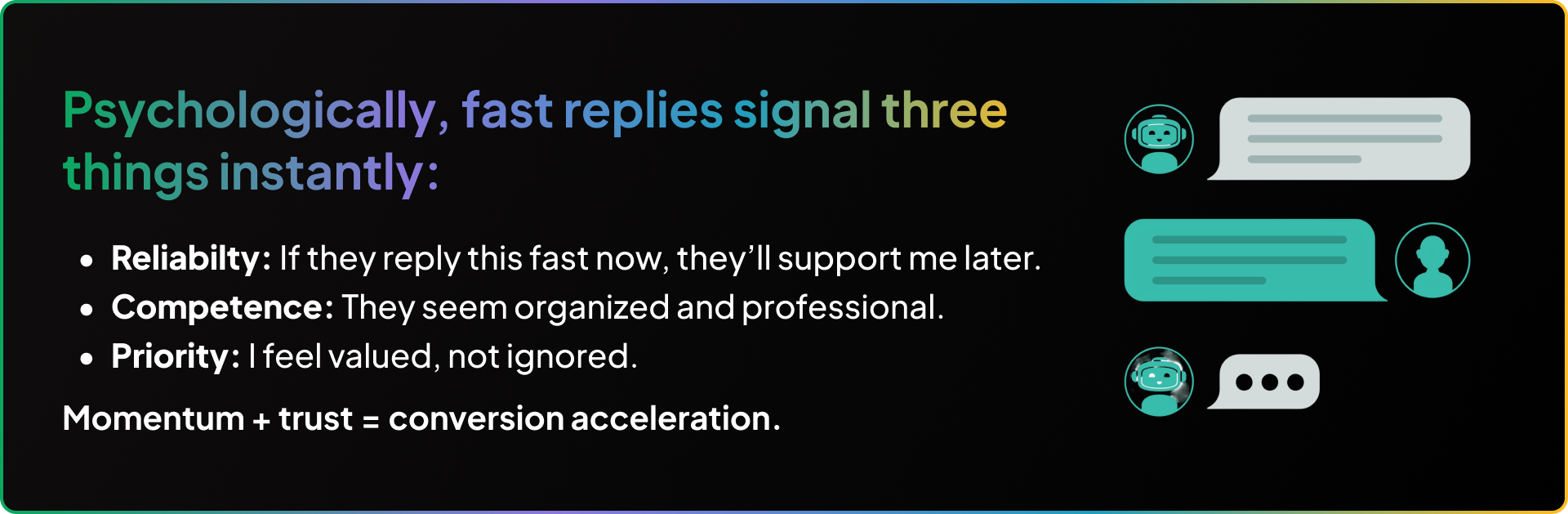
The moment a lead reaches out, they're in motion, mentally comparing options, validating trust, and testing responsiveness. That micro-window of intent is where conversions are decided. Miss it, and no amount of persuasion later can fully recover the lost momentum. This is why response time conversion has become one of the most powerful performance indicators in modern sales and service businesses.
The Pattern Across Industries
Across industries like clinics, salons, local retail, real estate, and professional services, the pattern is identical: the business that responds first usually closes first.
- A dental clinic replying within 60 seconds secures the appointment before the competitor finishes lunch
- A salon confirming availability instantly locks the booking before the customer scrolls further
- A retail brand answering size and delivery questions immediately removes hesitation and triggers purchase intent
This is why instant reply automation is no longer optional—it's the baseline of competitive survival for SMBs.
Speed Plus Structure
But speed alone isn't enough. The real advantage comes from follow-up workflows that sustain momentum after the first reply. High-performing teams don't rely on memory or sticky notes. They use behavior-driven sequences:
- If the lead replies → escalate instantly
- If the lead goes silent → auto-reminder after 24 hours
- If interest is high → trigger booking links or callbacks
- If the lead stalls → re-engage with contextual nudges
This layered execution multiplies conversion probability without increasing human workload. The compounding effect is brutal: faster first replies increase engagement, structured follow-ups increase close rates, and consistent execution increases predictable revenue. That's how small teams outperform larger competitors who rely on manual follow-ups and delayed responses.
Slow response is invisible revenue leakage. You don't see the deal you never got. But your competitor does.
And once instant replies become the foundation, the next question becomes unavoidable: if speed drives conversion, what system actually enables that speed at scale without exhausting humans, and without losing context across conversations?
Putting It Together — CRM + Chat + Automation
"Alone they store, they talk, they nudge. Together they close."
Most small businesses already own pieces of the puzzle:
- A CRM to store leads
- A chat app to reply to messages
- Some form of automation to send reminders
Yet conversions remain inconsistent because these tools operate in silos. Data lives in one place. Conversations live in another. Follow-ups depend on human memory. Nothing flows.
The Unified Conversion Loop
A true unified growth stack for SMBs connects these layers into a single execution loop where every action feeds the next decision automatically. This is what turns disconnected software into a conversion engine automation system.
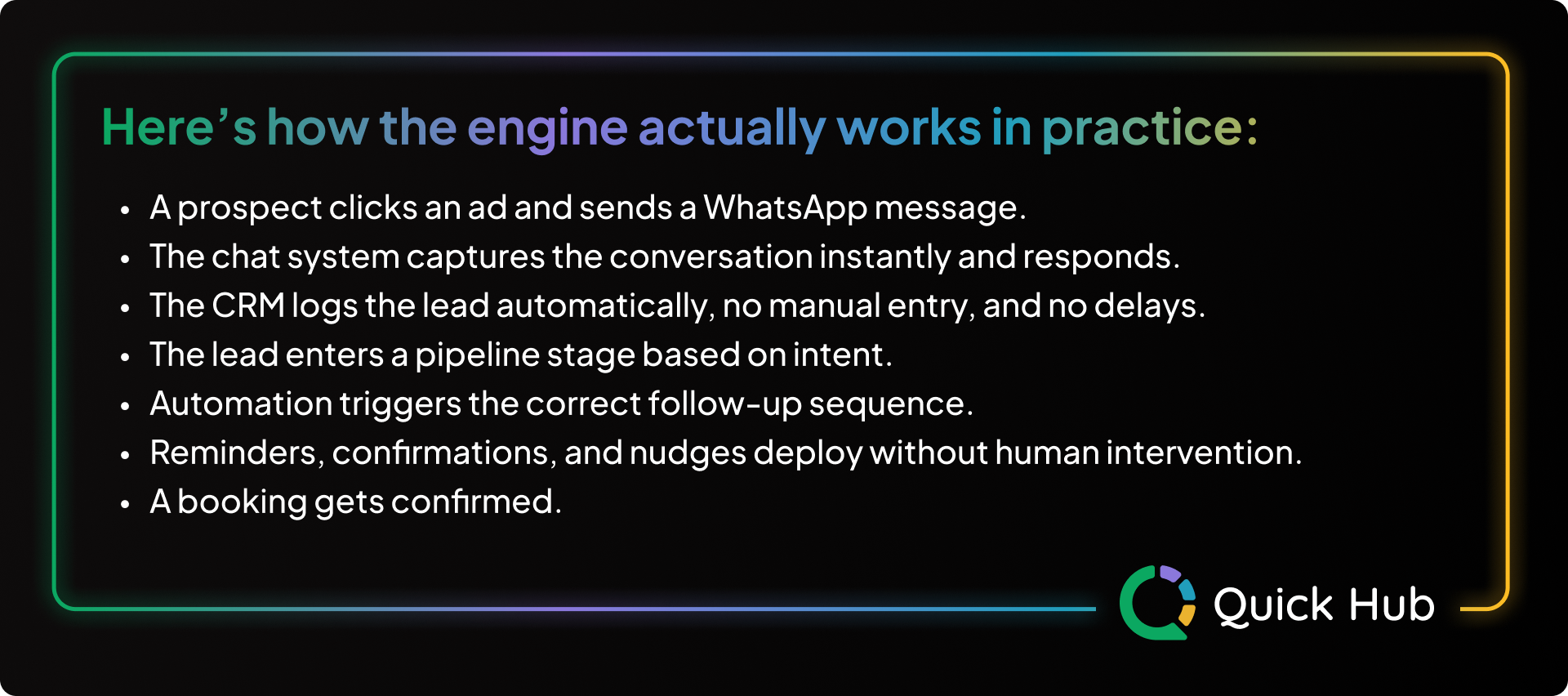
Here's how the flow works:
- Capture: A lead arrives across any channel and is instantly logged
- Route: The system qualifies and assigns ownership automatically
- Engage: AI handles instant replies, capturing intent and qualification signals
- Move: The CRM updates in real time, activating follow-up workflows
- Close: Multi-touch sequences maintain momentum until conversion
- Post-Sale: The system prepares the next action—onboarding, review request, or re-engagement
That's not marketing. That's operational flow.
This is the power of CRM chat integration when it's designed as infrastructure rather than software. Conversations don't disappear into message threads. They become structured data. That data activates workflows. Workflows move revenue forward. Every interaction compounds intelligence instead of creating noise.
The Visibility Advantage
The real advantage is visibility. Teams no longer ask:
- "Did someone reply to this lead?"
- "Who owns this conversation?"
- "Did we follow up?"
- "Where did this customer come from?"
The system already knows, and already acted.
When CRM pipelines reflect live conversations, and automation executes instantly based on behavior, conversion becomes predictable instead of hopeful. You stop chasing leads. You start engineering outcomes.
This is why modern operators think in systems, not tools. A CRM without chat is blind. Chat without automation is fragile. Automation without CRM is dumb. But together, they form a self-reinforcing loop that captures intent, maintains momentum, and eliminates human latency.
Once this conversion engine is running, something interesting happens: the bottleneck shifts. Speed improves. Follow-ups stabilize. Visibility increases. And now the real competitive edge emerges: who can scale this engine cleanly without adding operational complexity or technical debt?
That's where platforms begin to matter, and why the next section examines how execution platforms are redefining what "conversion infrastructure" actually looks like for modern SMBs.
Why QuickHub Is the Engine That Makes This Real
"Stop patching apps. Start running your growth engine."
Most SMBs don't fail because they lack effort. They fail because they're duct-taping growth together with disconnected tools:
- A CRM that stores but doesn't act
- A chat app that replies but doesn't route
- An automation tool that sends messages but doesn't understand context
Every handoff creates friction. Every integration adds fragility. Every manual step slows conversion velocity.
QuickHub eliminates that entire problem by functioning as a true SMB growth operating system, not just another piece of software.
Instead of stitching together five platforms, QuickHub unifies CRM, chat, automation, AI agents, campaigns, follow-ups, reviews, and analytics into one execution layer. One customer profile. One workflow engine. One source of truth. That's what turns theory into a working unified conversion engine.
Real Execution Inside QuickHub
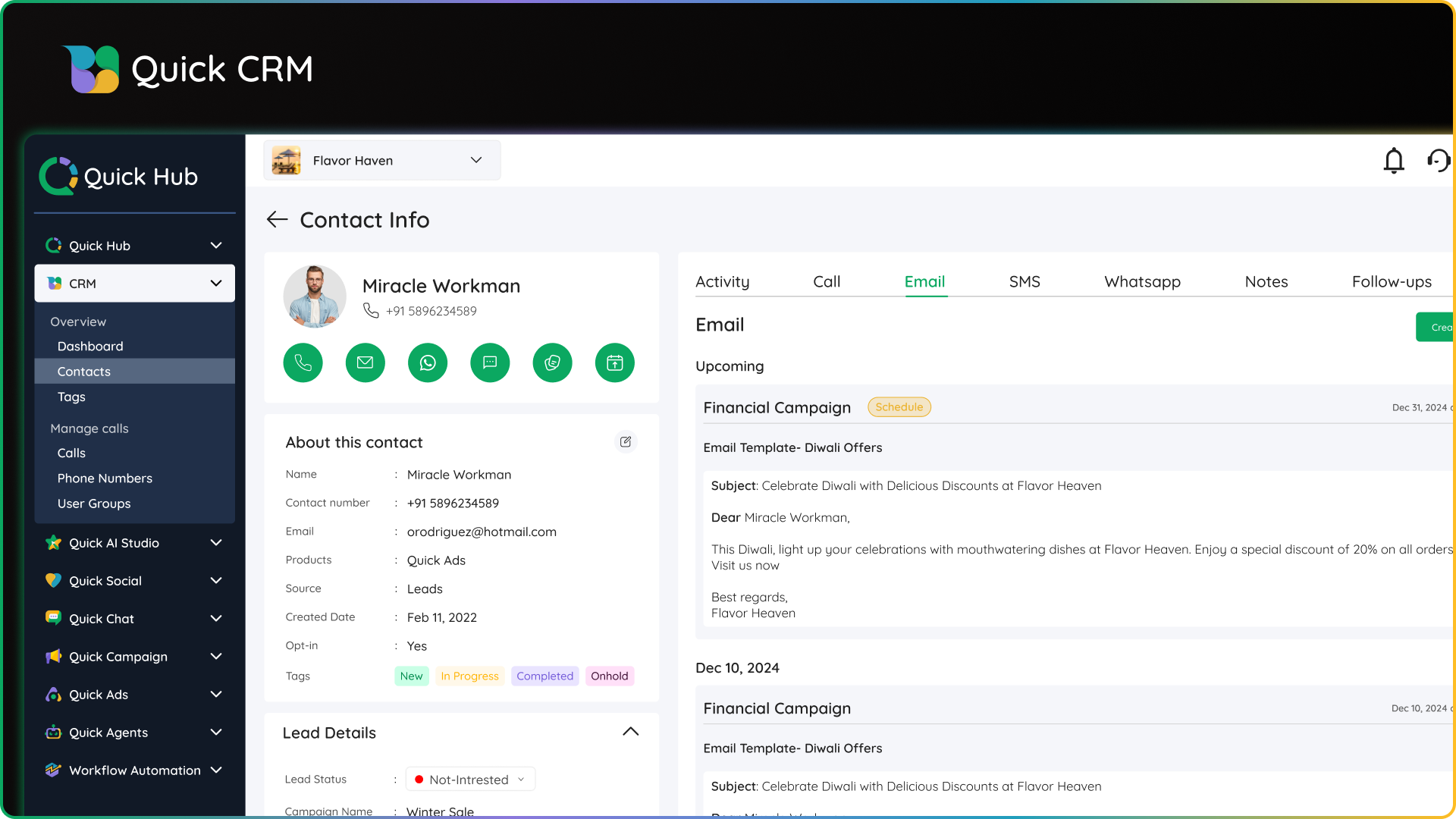
Here's what real execution looks like inside the QuickHub CRM automation platform:
- A lead arrives from WhatsApp, Instagram, website chat, or paid ads
- The system auto-routes the inquiry based on rules or intent
- AI replies instantly, capturing attention while humans are busy
- The CRM logs the lead automatically into the correct pipeline stage
- Follow-up automation triggers based on behavior, not guesswork
- Appointments, reminders, and confirmations deploy without manual chasing
- Revenue dashboards update in real time—visibility without spreadsheets
No missed leads. No delayed replies. No disconnected campaigns. No blind spots.
The Infrastructure Shift
This isn't about adding more features. It's about removing operational drag from the entire revenue journey. When execution becomes automated, response time collapses. Follow-up consistency stabilizes. Conversion predictability increases. Owners stop living inside inbox chaos and start managing outcomes.
This is why businesses adopting automation platforms like QuickHub don't describe it as "marketing software." They describe it as infrastructure—the engine that runs demand, conversion, and retention without burning human bandwidth.
In a market where speed beats perfection and execution beats ideas, the winners aren't the loudest advertisers. They're the best operators. And operators don't scale with more apps, they scale with systems that think, move, and optimize continuously.
Final Takeaway: The Operating System for Modern Conversion
Once your conversion engine is running inside a unified growth platform, the final question becomes unavoidable:
Are you still running your business manually, or are you finally operating it like a modern system built for scale?
Because in 2026, conversion isn't a marketing problem anymore. It's a systems problem. And the gap between scattered tools and unified platforms isn't a feature difference—it's the difference between friction and flow.
The businesses that win won't be the ones with the best pitch. They'll be the ones with the fastest response, the strongest follow-through, and the most connected systems. That's the new engine of consistent, predictable, scalable conversion.