

Introduction
"Most small businesses don't have a marketing team. So why do they still need to generate consistent demand?"
That sentence alone explains why so many small and mid-sized businesses feel stuck in a constant cycle of hustle, firefighting, and unpredictable growth.
Demand generation used to mean having a marketing department — campaign managers, funnel specialists, ad buyers, content calendars, and weekly reporting meetings. But most SMBs don't have any of that.
They have:
- One owner handling sales, operations, and finance
- One ops person trying to keep the lights on
- One phone that never stops buzzing with WhatsApp messages, missed calls, and half-followed-up leads
There's no marketing team. No growth architect. No one mapping funnels on whiteboards. And yet, customers still expect instant replies, consistent follow-ups, personalized experiences, and professional engagement across every channel.
This is where the pressure shows up. Leads arrive in unpredictable waves. Follow-ups happen when someone remembers. Ads feel like a gamble instead of a system. Some weeks are overloaded, others are painfully quiet. Growth feels reactive instead of engineered, more like luck than leverage.
The reality in 2026 is clear: consistent lead generation for SMBs no longer comes from effort alone. It comes from systems. Modern businesses are replacing manual marketing with automated demand generation, powered by connected platforms that unify CRM, conversations, campaigns, and workflows into one operational engine. Instead of chasing leads, the system captures, nurtures, qualifies, and routes demand automatically, even when the team is small.
This is why small business growth systems are becoming a real competitive advantage. Platforms like QuickHub are enabling SMBs to build always-on demand engines without hiring a marketing team:
- Centralizing leads
- Automating follow-ups
- Orchestrating campaigns
- Turning every inquiry into a structured revenue opportunity instead of chaos
Demand is no longer a department you staff. It's a system you design. If demand is now a system, the first question becomes: why do most small businesses still struggle to build one?
Why Most SMBs Struggle With Demand (Even When They're Busy)
"Being busy is not the same as building a pipeline."
Walk into almost any growing small business and you'll feel the motion immediately. Phones buzzing. WhatsApp pings every few minutes. Instagram DMs waiting for replies. Walk-ins asking questions. Forms coming in from ads. On the surface, it looks like momentum. Underneath, it's usually fragmentation disguised as activity.
Most SMBs don't actually have a demand system. They have scattered inputs:
- Leads split across WhatsApp, Instagram, website forms, phone calls, and spreadsheets
- No centralized CRM visibility to see who is hot, warm, cold, or forgotten
- No consistent follow-up discipline, everything depends on memory and mood
- No automation logic guiding what should happen next
- No attribution clarity showing what truly drives revenue
This is how lead leakage in SMBs quietly destroys growth. Messages get missed during busy hours. Promising inquiries cool off because no one followed up. Past customers disappear because no reactivation flow exists. Marketing feels like a slot machine instead of a predictable engine. The business stays busy, but demand stays inconsistent.
A real-world example
A neighborhood salon receives around 40 inquiries every week from Google, Instagram, and referrals. On paper, demand looks healthy. In reality, only 12 convert.

This isn't a traffic problem. It's a system problem.
This is exactly where platforms like QuickHub begin to change the equation. By centralizing conversations, leads, campaigns, and follow-ups into one operational layer, QuickHub removes the chaos that blocks consistent demand. Every inquiry lands in one inbox. Every lead lives in one CRM. Every follow-up can be automated. Every campaign becomes measurable. Instead of juggling apps, teams finally operate from a single source of truth.
When the inconsistent demand problem disappears, something powerful happens: growth becomes predictable instead of stressful. CRM for small businesses stops being a database and starts becoming a revenue engine.
Busy doesn't equal scalability. Systems do. Once chaos is removed, the next unlock is understanding what actually creates demand, and what doesn't.
Demand Isn't Ads — It's Speed, Follow-Up & Visibility
For years, small businesses were taught that demand equals ads.
- More spending
- More clicks
- More impressions
- More hope
But the truth is uncomfortable and liberating at the same time: ads only create attention. Demand is created by what happens in the first few minutes, and the days that follow.

Where revenue is actually won
An inquiry answered instantly feels alive. An inquiry answered after 20 minutes feels forgotten. An inquiry never followed up becomes invisible revenue.
In hundreds of real-world SMB stories, the pattern is identical. Businesses responding within the first two minutes dramatically outperform competitors replying after twenty. Not because the offer is better, but because momentum compounds. The customer is still emotionally engaged. The intent signal is fresh. The conversation flows naturally instead of feeling like a cold restart. Conversion velocity accelerates simply because speed creates confidence.
Now layer in follow-up. Most deals don't close on the first message. They close after reminders, clarifications, nudges, and reassurance. Multi-touch follow-ups quietly outperform one-shot replies every time. Add repeated exposure and consistency, and trust compounds even when the customer isn't ready today.
This is the real engine behind conversion optimization for SMBs and fast lead response automation. It's not flashy. It's operational excellence.
Platforms like QuickHub turn this execution layer into muscle memory:
- AI chat assistants respond instantly across channels
- A unified inbox prevents missed conversations
- Auto-routing assigns ownership immediately
- Instant workflows trigger follow-ups, reminders, and re-engagement automatically
Every inquiry becomes an active opportunity without waiting for someone to notice it.
Instead of hoping someone replies fast enough, the system does it by default. Instead of relying on memory, automation enforces consistency. Instead of losing visibility, every conversation stays connected inside one growth engine.
This is what modern chat automation for small business really means: not bots for novelty, but speed as a competitive advantage, built directly into daily operations.
Demand no longer belongs to the loudest advertiser. It belongs to the fastest responder with the strongest follow-through. If demand depends on execution speed and consistency, how do SMBs deliver that without a team?
The New Demand Engine — CRM + Automation + Campaigns Working Together
"Isolated tools create noise. Connected systems create momentum."
Most small businesses don't suffer from lack of effort. They suffer from disconnected motion. Ads run in one dashboard. Messages live in five inboxes. Follow-ups depend on memory. Customer history disappears between conversations. The result isn't just inefficiency, it's lost momentum at every handoff.
The modern demand engine is surprisingly simple
CRM remembers every customer: Who they are, what they asked, what they bought, what stage they're in, and what should happen next.
Automation moves every lead: No waiting, no forgetting, no guessing. Actions fire automatically based on behavior, timing, and intent.
Campaigns create attention: Ads, broadcasts, promos, and retargeting bring new conversations into the system.
Individually, these tools are helpful. Connected, they become a revenue engine.
When the stack is unified, momentum compounds automatically:
- A campaign triggers a conversation
- That conversation updates the CRM in real time
- The CRM triggers follow-up automation
- Automation triggers reactivation when interest cools
- Every action feeds the next step without manual stitching
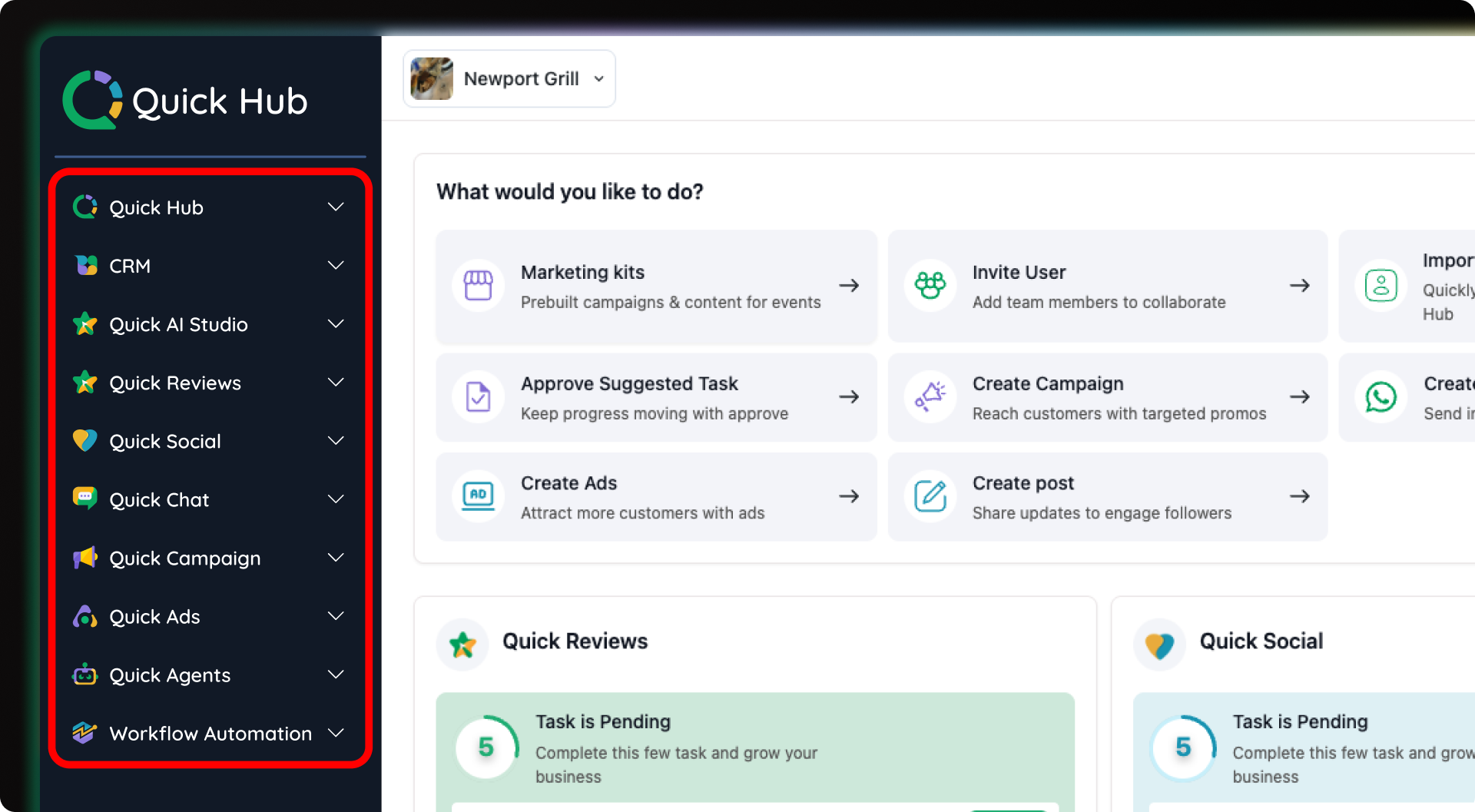
This is what a true marketing automation system looks like in 2026: not scattered software, but a single flow that keeps customers moving forward continuously.
This is exactly where QuickHub changes the game. Instead of forcing SMBs to juggle integrations and fragile workflows, QuickHub combines CRM, campaigns, chat, reviews, automation, and analytics into one connected growth operating system. No tool sprawl. No broken handoffs. No invisible data gaps. Everything lives in one execution layer designed for real-world small business velocity.
A simple example shows the power of this connection
A Facebook ad drives a prospect to WhatsApp. QuickHub auto-replies instantly with an intelligent response. The lead is automatically created and assigned in the CRM. A follow-up sequence activates without human involvement. A booking confirmation is sent the moment an appointment is scheduled. After the visit, a review request triggers automatically. That review feeds future campaigns and social proof.
No chasing. No copy-paste. No dropped steps. Just a living system that converts attention into revenue.
This is why CRM automation campaigns and unified growth platforms for SMBs are replacing scattered stacks everywhere. Not because they're trendy, but because they finally align with how demand actually flows.
When systems are connected, execution stops depending on perfect human behavior and starts operating with mechanical reliability.
Momentum becomes automatic.
How SMBs Generate Daily Demand Without a Marketing Team
The biggest myth in small business growth is that consistent demand requires a full marketing department:
- A content manager
- A performance marketer
- A CRM admin
- A campaign coordinator
- A reporting analyst
Most SMBs don't have any of that, and yet the fastest-growing ones are generating daily leads, steady bookings, and predictable revenue without hiring a single extra person.
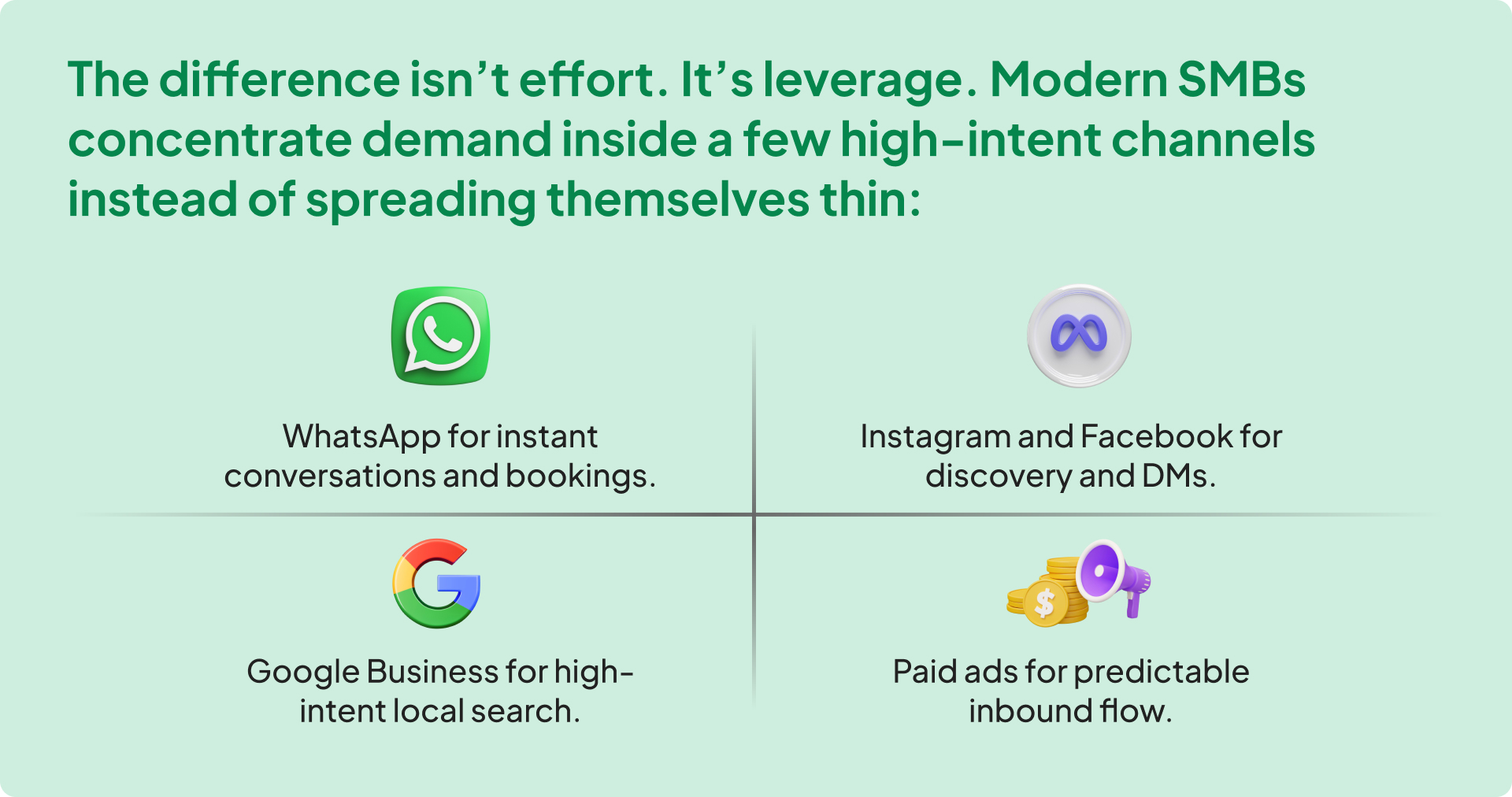
The channels already exist in most businesses. What changed now is how they're operated. Instead of humans manually replying, routing, and remembering follow-ups, AI marketing for SMBs now handles the operational layer automatically.
Here's how small teams scale without people
- AI auto-responders handle first replies in seconds, not hours
- Smart routing rules send hot leads to the right owner instantly
- Automated follow-ups ensure no inquiry ever goes cold
- Scheduled campaigns keep demand flowing even when the business is busy
- Review generation loops convert happy customers into future demand engines
QuickHub becomes a growth multiplier rather than just software. With a unified inbox across channels, businesses see every WhatsApp message, Instagram DM, form submission, and campaign reply in one place. AI chat assistants qualify inquiries automatically. Campaign automation keeps outbound demand consistent. CRM pipelines track every opportunity. Review automation builds trust at scale. Calendar scheduling eliminates friction. And lead scoring prioritizes revenue automatically.
A neighborhood clinic illustrates this shift perfectly
Every week, the clinic runs WhatsApp campaigns directly through QuickHub. AI handles the first wave of responses instantly, answering basic questions and qualifying intent. Each lead is captured inside the CRM automatically. Follow-ups trigger without manual effort. Reminders go out if someone delays booking. Only fully qualified appointments reach the owner's phone.
The owner doesn't chase leads. The system delivers booked patients. That's the real meaning of lead generation without a marketing team. Not fewer activities, but fewer manual dependencies. Not more hustle, but more automation depth. Not more tools, but tighter orchestration.
This is why WhatsApp marketing automation, AI marketing for SMBs, and unified growth platforms are becoming the default operating model for modern small businesses. Demand no longer lives in campaigns alone. It lives inside systems that run continuously, quietly, and reliably.
Demand doesn't stop at acquisition. The real growth comes after the first conversion.
Why Repeat Buyers Create Predictable Demand (Not Ads)
"The cheapest lead you'll ever get is the one who already trusts you."
Most small businesses chase demand the hard way:
- More ads
- More spend
- More experiments
- More stress
Every month starts from zero again. New clicks. New leads. New uncertainty.
But predictable demand doesn't come from ads. It comes from relationships that compound. A returning customer already knows your brand. They've experienced your service. They trust your delivery. There's no education phase, no credibility gap, and no hesitation loop. Conversions happen faster, at lower cost, with higher confidence. This is why retention marketing for SMBs consistently outperforms pure acquisition in lifetime profitability.
Repeat buyers drive
- Lower acquisition cost: You're not paying platforms to rediscover your own customers
- Faster conversions: Trust shortens the decision cycle dramatically
- Higher lifetime value: Multiple purchases stack over time
- More referrals: Happy customers become organic growth channels
The challenge is that most SMBs don't operationalize retention. They remember customers emotionally, not systematically. Names in phones. Old invoices in folders. Messages buried in WhatsApp history. There's no structured way to activate past buyers consistently.
This is where repeat customer automation becomes a growth advantage.
Smart systems create invisible revenue loops through:
- Re-engagement campaigns that bring dormant customers back at the right moment
- Seasonal reminders aligned with buying cycles and usage behavior
- Upsell workflows triggered by past purchases or service history
- Review loops that convert satisfaction into visibility and referrals
Instead of guessing who to contact and when, the system does the remembering.
QuickHub makes this practical for everyday operators, not just enterprise marketers. With CRM segmentation, businesses can group customers by behavior, frequency, and value. Automated campaigns activate those segments without manual lists. Customer history visibility ensures every conversation has context. Behavior-based triggers turn actions into follow-ups automatically.
A local service business might automatically re-invite customers six months after their last visit. A gym triggers upsell offers when attendance frequency drops. A clinic sends preventive care reminders based on visit history. None of this requires a marketing manager. It requires a system that connects data to action.
This is what lifecycle marketing looks like when simplified for small businesses: Not complex funnels. Not endless dashboards. Just consistent, automated value delivery to people who already trust you.
And the compounding effect is powerful. Over time, repeat buyers stabilize cash flow, reduce dependency on volatile ad platforms, and smooth out seasonal swings. Demand becomes less reactive and more engineered.
When retention is automated, growth stops being fragile.
Practical Playbook — Building a Demand Engine in 30 Days
The biggest mistake SMBs make with automation is overengineering before they've even fixed the basics. They chase advanced funnels, complex dashboards, and shiny AI features, while leads are still getting missed, replies are still slow, and follow-ups are still inconsistent.
A real demand generation framework doesn't start with complexity. It starts with flow.
Here's a simple, battle-tested way to stand up a working demand engine in just 30 days using a connected platform like QuickHub, without hiring a marketing team, without technical debt, and without disrupting daily operations.
Week 1: Centralize Conversations
Your first goal is visibility. Every customer interaction — WhatsApp, Instagram, website chat, Facebook messages, form submissions — must land in one place. When conversations live across devices and apps, no automation can save you.
By moving all channels into the QuickHub unified inbox, you immediately gain:
- One timeline per customer
- No missed messages
- Faster response coordination
- Clear ownership visibility
This single step alone reduces lead leakage dramatically and sets the foundation for every future automation layer. This is the heartbeat of any scalable SMB automation setup.
Week 2: Activate CRM Pipelines
Once conversations are centralized, structure follows.
Define clear pipeline stages:
- New inquiry
- Qualified lead
- Booked
- Completed
- Repeat opportunity
Assign ownership so every lead has accountability. Now your business stops guessing where revenue lives. You can see bottlenecks, stalled deals, and conversion velocity in real time inside QuickHub's CRM pipelines. You're no longer operating on gut instinct, you're operating on flow visibility.
Week 3: Launch Automation
Now the system starts working for you.
Activate:
- Instant replies to capture intent the moment it arrives
- Automated follow-ups to eliminate forgotten leads
- Review requests to compound trust and discovery
Instead of humans remembering tasks, the system executes them consistently. This is where your growth system stops leaking.
Week 4: Run Campaigns
With execution stabilized, you feed the engine.
Launch:
- WhatsApp broadcast campaigns
- Social retargeting flows
- Referral and reactivation campaigns
Because campaigns are now connected to CRM and automation inside QuickHub, every response flows directly into pipelines and follow-ups automatically, not into chaos. In 30 days, you've built a working growth system blueprint, not just a tool stack.
Why Platforms Like QuickHub Are Replacing Marketing Teams
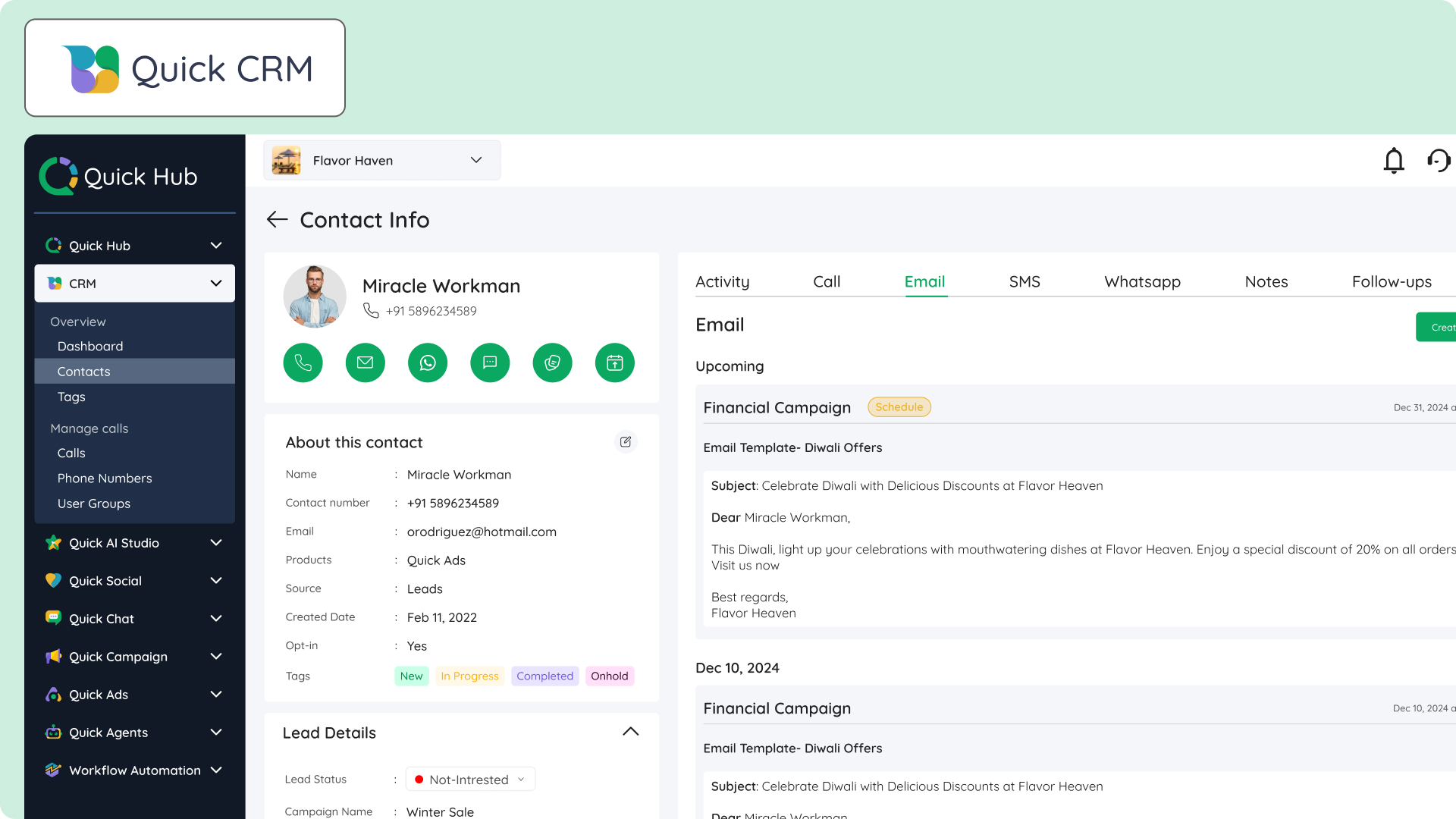
For decades, growth meant headcount. A marketer to run campaigns. A coordinator to follow up leads. Someone to manage tools, dashboards, and reports. That model worked when attention was cheap and customers were patient. In 2026, neither is true.
Today, the businesses winning consistent demand aren't hiring faster, they're executing faster. And that's exactly why platforms like QuickHub are quietly replacing traditional marketing teams for modern SMBs.
Not by doing "marketing." But by running the entire growth machine automatically.
What QuickHub Replaces (Without Adding Complexity)
Most SMBs accidentally build:
- One CRM tool to track leads
- A separate chat app for WhatsApp and social messages
- A different campaign platform for email and broadcasts
- Standalone automation tools for workflows
- Another platform for reviews and reputation
- Yet another dashboard for analytics and reporting
Each tool solves one problem, but creates ten handoffs, logins, integrations, and blind spots.
QuickHub collapses this sprawl into one connected execution layer:
- CRM
- Unified inbox
- Campaigns
- Automation workflows
- Review management
- AI assistants
- Revenue visibility
All operating inside one system, on one customer profile, moving one journey forward. That's why businesses increasingly refer to QuickHub not as software, but as a growth operating system.
Why SMBs Are Choosing All-in-One Automation Platforms
- Faster setup: No complex integrations. No vendor juggling. Teams go live in days, not months
- Lower operational cost: Replacing multiple subscriptions, support contracts, and manual labor with one unified platform reduces overhead immediately
- Less complexity: One login. One workflow engine. One source of truth. Teams stop wasting energy reconciling systems
- Higher execution speed: Leads are routed instantly. Follow-ups trigger automatically. Campaigns feed pipelines without manual work. Decisions move faster because the system pushes them forward
This is why the demand for QuickHub marketing platform, all-in-one SMB automation, and growth operating systems continue to surge. SMBs don't want more features. They want momentum.
The Real Shift: From Hiring to System Design
The smartest operators aren't asking: "Who should we hire next?"
They're asking: "What should the system execute automatically next?"
When your CRM talks to your inbox. When campaigns trigger workflows. When AI handles response speed. When reviews feed discovery. When analytics show revenue movement, not vanity metrics.
That's not marketing. That's infrastructure. And infrastructure scales without burnout.
Final Takeaway — Consistent Demand Is a System Decision
"The businesses that win won't work harder. They'll operate smarter."
For years, small businesses were taught to chase tactics:
- Launch more campaigns
- Post more content
- Spend more on ads
- Hire another person
But consistent demand doesn't come from activity. It comes from execution discipline powered by systems.
Demand is no longer a marketing function. It's not a department. It's not a calendar of promotions.
Demand today is:
- How fast do you respond?
- How reliably do you follow up?
- How clearly do you track intent?
- How consistently do you re-engage?
- How smoothly your workflows move customers forward?
In other words, demand is operational.
That's why modern SMBs are shifting toward unified growth platforms and automation-first execution models instead of stacking more tools and people. Platforms like QuickHub allow small teams to run enterprise-grade demand engines, combining CRM, AI chat automation, campaigns, workflows, reviews, and revenue visibility into one connected system.
When the system runs correctly, businesses:
- Respond instantly across every channel
- Convert faster with zero lead leakage
- Retain longer through automated lifecycle engagement
- Scale predictably without burning out teams
Not because they work harder. But because the system works continuously.
Consistent demand doesn't come from campaigns alone. It comes from building a growth engine that never forgets to follow up, never sleeps, never loses context, and never drops a customer — automatically.